
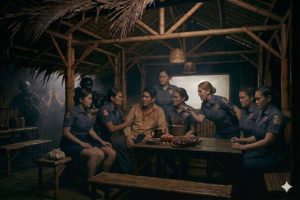
 You were invited.
That was the word they used.
“Invited.”
Which is an impressive choice of language, because in most situations, an invitation involves at least one of the following: food, music, or at least the faint expectation of joy.
This invitation had none of those.
Instead, it had a chair that made you sit like you were attending your own sentencing, a table that had seen more regret than closure, and a calm voice that said:
“We just need to ask you a few questions.”
There is no RSVP card for this kind of invitation.
No dress code.
But somehow, you still feel underdressed.
And because you are a reasonable person, you think:
Of course. I will cooperate. I will explain. I will help clarify things.
That is usually the exact moment things begin to drift in a direction you did not plan.
⚖️ The First Mistake: Thinking This Is Optional (Or Casual)
The word “invited” does a lot of work.
It sounds friendly.
Voluntary.
Almost polite.
Like you can say:
“Ay, pass muna. May lakad ako.”
But the reality is more… structured.
Because the moment you step into that station, sit down, and someone starts asking questions—
you are no longer just “visiting.”
You are participating in something the law takes very seriously.
Even if it doesn’t feel like it yet.
⚖️ The Second Mistake: Thinking You Can Talk Your Way Out
You sit down.
Someone offers you water.
Another person asks:
“Kwentuhan mo lang kami, sir. Ano ba nangyari?”
And this is where the human instinct kicks in:
Explain.
Clarify.
Be helpful.
Because in normal life, talking solves problems.
In legal settings?
Talking creates records.
⚖️ The Law Actually Saw This Coming
This situation is not new.
The Supreme Court has repeatedly warned about exactly this moment—when a person starts speaking without fully understanding the consequences.
In People v. Mahinay, the Court laid down the now-famous guidelines:
- You have the right to remain silent
- You have the right to competent and independent counsel
- Anything you say can be used against you
And more importantly:
these rights must be explained clearly and effectively, not casually mentioned like house rules.
Because once you start answering questions—
those answers don’t stay in the room.
⚖️ “Relax Lang” Is Not a Legal Standard
There is a very specific stage called custodial investigation.
And once you’re in it, your rights are not optional.
In People v. Basay, the Court emphasized that:
admissions made during custodial investigation without proper safeguards are inadmissible.
Which sounds technical, until you realize what it means:
If your rights are not properly respected, your statements may be excluded.
But here’s the problem.
Most people don’t argue admissibility at the station.
They just talk.
⚖️ The Dangerous Middle: When It Feels Informal (But Isn’t)
Not every questioning starts with:
“You have the right to remain silent…”
Sometimes it starts with:
“Sir, tulong lang.”
And that’s where things get blurry.
Because legally, once questioning becomes accusatory—
your rights must already be in place.
The Court has made this clear in People v. Andan:
even statements made before formal charges can fall under custodial investigation if the person is already under suspicion.
Translation:
You don’t get a warning sign that says:
“Legal consequences start here.”
It just… happens.
⚖️ The Problem With “Just Explaining”
Let’s say you try to be cooperative.
You say:
“Nandun lang ako… pero hindi naman ako kasama…”
What you meant:
- you weren’t involved
What gets recorded:
- you were there
And now, you’re part of the story.
Not because you were guilty.
But because you placed yourself inside it.
⚖️ Silence Feels Wrong—But It’s Actually Right
Most people think staying silent looks suspicious.
So they talk to appear innocent.
But legally, silence is not an admission.
It is a right.
In fact, the Constitution protects it for a reason:
because people tend to say things that hurt them when they are unsure.
⚖️ “But I Didn’t Confess”—You Don’t Need To
Here’s where people get it wrong.
They think:
“Wala naman akong inamin.”
But incrimination is not always dramatic.
It’s not always:
“Yes, I did it.”
Sometimes it’s this:
“Nandun ako… pero hindi ako kasama.”
Let’s break that down.
🧠 What you meant:
- You were not involved
⚖️ What the record now shows:
- You were present
- You were at the scene
- You are connected
Congratulations.
You just placed yourself inside the story.
⚖️ Sample Situations (Where Things Quietly Go Wrong)
🗣️ Example 1:
Effect:
- You just admitted physical contact
- The only thing left to argue is whether it was justified
🗣️ Example 2:
Effect:
- You just admitted intent or motive
🗣️ Example 3:
Effect:
- You just confirmed presence at the scene
🗣️ Example 4 (Classic Overexplaining):
Effect:
- You just improved the prosecution’s case for a different crime
⚖️ “Eh Nasabi Ko Na… Aarestuhin Na Ba Ako?”
Short answer:
👉 Not automatically.
Long answer:
Your statement alone does not instantly trigger arrest.
But it can:
- justify further investigation
- support a complaint or charge
- be used as evidence against you
And once formal charges are filed—
that “usap lang” becomes part of a case file with your name on it.
⚖️ Can That Statement Be Used Against You?
Here’s where doctrine matters.
In People v. Galit, the Court ruled:
any waiver of the right to counsel must be made knowingly and with assistance of counsel.
And in People v. Basay, the Court emphasized:
statements taken without proper custodial safeguards may be inadmissible.
So yes—
👉 If taken improperly, your statement can be excluded.
⚖️ But Here’s the Frustrating Reality
That doesn’t mean you’re safe.
Because even if your statement becomes inadmissible:
- it may lead police to other evidence
- it may shape the direction of the case
- it may still appear in records or affidavits
So while your lawyer may later argue:
“That statement should not be used.”
The damage?
Already… partially done.
⚖️ Likely Defenses (If You Already Talked Too Much)
If things reach court, your lawyer will start cleaning up what happened earlier.
Common defenses include:
⚖️ 1. Violation of Custodial Rights
- No proper warning
- No counsel present
⚖️ 2. Inadmissibility of Statement
- Statement taken in violation of rights
- Improper waiver
⚖️ 3. Contextual Clarification
- Your statement was incomplete or misinterpreted
⚖️ 4. Independent Evidence Weakness
- Even without your statement, the case is weak
But notice something:
All of these are defensive.
They are not:
“We planned this.”
They are:
“We are trying to fix what already happened.”
⚖️ The Moment You Should Have Stopped
There is always a moment.
A very specific moment.
When the questions stop being casual and start becoming focused.
You feel it.
You just don’t act on it.
That’s when you should say:
“I would like to have counsel present.”
Not loudly.
Not dramatically.
Just clearly.
Because that sentence does one thing:
it stops you from becoming your own evidence.
⚖️ The Real Problem
The biggest mistake is not talking.
It’s thinking you are still in a normal situation while you are already in a legal one.
You adjust your tone.
You stay polite.
You try to help.
Meanwhile, the system is doing something else entirely:
it is documenting you.
⚖️ The Illusion of “Just a Conversation”
The first questions are simple.
Where were you?
Who were you with?
Do you know this person?
It feels casual, almost harmless. Like a conversation that just happens to be happening in a slightly more formal chair.
So you answer.
Then you elaborate.
Then you clarify things that were never asked, because silence suddenly feels suspicious and explanation feels safe.
But here is the uncomfortable shift:
You are not in a casual conversation.
You are in what the law recognizes as custodial investigation—a stage where statements begin to carry evidentiary weight.
⚖️ The Law Has Already Seen This Happen
The Supreme Court has dealt with this scenario more times than people realize.
In People v. Mahinay, the Court laid down strict safeguards:
A person under custodial investigation must be informed of:
- the right to remain silent
- the right to counsel
- the fact that any statement may be used as evidence
Not vaguely. Not casually. Clearly.
Because once questioning starts, the legal system assumes something very important:
that the person understands the consequences of speaking.
Even when, in reality, most people are just trying to “explain themselves.”
⚖️ The Right to Counsel Is Not Decoration
Another common mistake:
“Okay lang, sasagot lang naman ako.”
Without a lawyer.
The Supreme Court has been strict about this.
In People v. Galit, it ruled that:
waivers of the right to counsel must be made knowingly, intelligently, and with assistance of counsel.
Meaning:
You don’t casually give up your rights.
And if you do it wrong—
the entire process becomes questionable.
⚖️ What a Lawyer Actually Does in Custodial Investigation
This is the part most people underestimate.
A lawyer at this stage is not there to “argue” in the dramatic sense. They are not there to deliver speeches or win points.
Their real function is quieter—and far more important.
A lawyer:
- ensures that questioning does not go beyond legal limits
- stops questions that are leading, coercive, or confusing
- translates what is being asked into legal risk in real time
- prevents the suspect from making statements that unintentionally admit elements of an offense
- ensures that any waiver of rights is not done under pressure or misunderstanding
In short, a lawyer is not just a speaker in the room.
They are a filter between you and consequences you do not yet understand.
And this is not optional protection.
It is constitutional protection.
⚖️ What “Competent and Independent Counsel” Really Means
The Constitution does not just say “a lawyer.”
It says competent and independent counsel.
This matters.
Competent means the lawyer must be able to understand criminal procedure—not just legally present, but actually capable of protecting rights in real time.
Independent means the lawyer must not be influenced by the police or prosecution, and must represent only the interest of the person under investigation.
Jurisprudence has repeatedly warned against “token lawyers”—those who are present physically but not meaningfully protecting the accused.
Because a lawyer who does not intervene is not protection.
They are decoration.
And the Court has never treated constitutional rights as decorative.
⚖️ Why This Matters in Real Life (Not Just Theory)
Without counsel, a simple statement like:
“I was there, but I didn’t do anything.”
can quietly become:
- an admission of presence
- a foundation for further questioning
- a structure for building a case theory
With counsel, that same moment would likely be handled differently:
The lawyer may advise silence.
Or limit the answer.
Or redirect the questioning entirely.
Not because you are guilty.
But because words, once spoken in that setting, rarely stay neutral.
⚖️ “But I Didn’t Confess”—That Is Not the Standard
People often think danger only comes from confessions.
It doesn’t.
It comes from partial statements, explanations, clarifications, and the urge to sound reasonable in an unreasonable setting.
Because in custodial investigation, the problem is not only what you admit.
It is what you accidentally place yourself inside.
⚖️ Will You Be Arrested If You Talk?
Not automatically.
There is no immediate trigger that converts speech into handcuffs.
But statements can:
- justify filing of charges
- support affidavits and complaints
- guide police investigation
- and become part of the narrative built against you
So the effect is rarely instant.
It is cumulative.
Which is why people often realize the impact only later—when everything they said starts reappearing in documents they no longer control.
⚖️ Can It Be Challenged Later?
Yes.
Your lawyer may later argue that:
- your rights were not properly explained
- your waiver of counsel was invalid
- your statements were inadmissible
In People v. Galit, the Court stressed that waiver of counsel must be made knowingly and intelligently.
In People v. Basay, it reiterated that custodial safeguards are not optional—they are constitutional guarantees.
So yes, violations can be raised.
But litigation is not a time machine.
It can correct errors.
It cannot undo the fact that words were already spoken into the record.
⚖️ The Moment You Usually Miss
There is always a point where the tone shifts.
Questions become more focused.
Less conversational.
More precise.
That is not the moment to “explain better.”
That is the moment to pause and say:
“I would like to have counsel present.”
Not as confrontation.
But as recognition that the situation is no longer informal.
⚖️ Final Thought (And the Missing Lechon Situation)
You were invited.
You showed up expecting a short conversation.
Maybe a quick clarification.
Maybe a polite exchange.
What you did not expect was that every sentence would start taking on a life of its own—carefully recorded, quietly stored, and later replayed in a setting where tone no longer matters.
By the time you leave, there is no celebration.
No resolution.
No lechon.
Just a growing realization that what felt like conversation was actually construction.
And now, instead of enjoying anything at all, you are left with the uncomfortable skill of replaying your own words in your head—like a man who came to a feast expecting food, and instead slowly discovered he had been doing all the eating himself.
No lechon.
No celebration.
No exit strategy.
Just silence.
And the deeply humbling realization that somewhere along the way, you did not just answer questions—you volunteered portions of your own case in bite-sized servings, until there was nothing left but regret and procedure.
And at that point, there is really only one accurate description of your situation:
You are standing there, full of confidence earlier, now emotionally empty…
and somehow considering whether it is physically possible to bite your own elbow, just to confirm that at least one impossible thing still feels achievable.